Category: Movie Reviews

Brother 0

Brother

Many films that tackle Black stories prioritize plight, treating their characters as inconsequential stand-ins for a thesis on trauma and pain. More successful, powerful films devote their narrative effort to how characters move through their environments. They afford their subjects agency and identity, rendering them as individuals instead of thoughtless symbols of the Black experience. It’s a nuanced distinction, but prioritizing character relays a deeper level of understanding and empathy, which Clement Virgo’s “Brother” executes poignantly.

“Brother” opens with brothers Francis (Aaron Pierre) and Michael (Lamar Johnson) climbing up electrical towers. Francis leads, instructing younger brother Michael to follow his every move. He signals that the buzzing will get louder the higher they climb, but all Michael needs to do is follow his example, and they’ll make it to the top. This vignette becomes a metaphor for their lives as “Brother” threads together three timelines: their childhoods, adolescence in high school, and young adult years. 

The sons of a single mother, a Caribbean immigrant to Scarborough, Canada, Francis and Michael couldn’t be more different. Francis is confident, physically imposing in height and musculature, and a leader among his family and peers. Michael is meek and reserved, a small fish in the pond of an increasingly hostile environment. As Francis finds himself straddling a life of family and ambition while walking a tightrope with a gang-affiliated friend group, the brothers begin facing questions of masculinity and tenacity as they age, coming face to face with the consequences of an anti-Black world in all its forms. 

Pierre and Johnson’s excellent chemistry is integral to the film’s success. They are believable as brothers not only through performance but also through the script’s ability to showcase the symbiotic relationship they have. One’s fear begets the vigilance of the other, just as one’s reservation influences the other’s proactivity. Pierre’s stoicism is a major marker of Francis’s strength against the odds, so when he breaks, showing tenderness and vulnerability, the moments hit with full impact. His indomitable facade doesn’t feel overly constructed or contrived, and Pierre performs each end of the spectrum with touching empathy in body and expression. 

Johnson, on the other hand, is always easy to read, constantly wearing his heart on his sleeve. Though Michael doesn’t intend to be seen, it can’t be helped, and this openness of character is precisely what incites so much love for him. He isn’t painted as a victim but as a dependent. And as we tour his life in Virgo’s three stages, it isn’t until we learn of Francis’ departure (the context of which isn’t explicitly revealed until the final act) that we see Michael come into his authority. He is the film’s emphatic core, driving the emotional weight and expressing it with sensitivity in its gravity, contrasting Francis’s stone-cold disposition.

As their neighborhood sees an uptick in gang violence, Francis withdraws. The brothers come of age during the 1990s hip-hop renaissance, as Michael’s dream is to be an emcee like Dr. Dre. Yet as he grows up, pulling further away from the family unit and into independence, the household is left rocked. Their mother, Ruth (Marsha Stephanie Blake), is a force of tough but tender love. Her ideas for the home are rigid, but her love for Michael and Francis butts against them in a typical head vs. heart dilemma. Blake gives a stunning performance as we view her development as much as Michael’s. From the boys’ childhood to Francis’ eventual departure, Ruth undergoes waves of change she can’t keep up with, and her relationship with Michael supplements the film’s heart after Francis leaves the picture.

Todor Kobakov’s spellbinding score glues the film’s emotional display to its stunning visuals. Played over meditative moments, the music brings “Brother” down to earth while warm versus cool color schemes paint the screen with damning dissonance. No feeling in “Brother” goes unfelt; every element of its filmmaking taps into the heart. As Michael navigates his memory, trying to reconcile ideas of masculinity against unforgiving circumstances, a study erupts: that of the spirit’s resolve and the immortality of familial love. “Brother” is a portrait of Black youth pitted against forces beyond their control. 

Now playing in theaters. 

Meg 2: The Trench 0

Meg 2: The Trench

Anyone hoping that Ben Wheatley might bring some of the exuberant personality and boundary-pushing creativity on display in films like “Kill List” and “In the Earth” to his for-hire gig directing the dismally boring “Meg 2: The Trench” should find different cinematic waters to swim in. Much as in his atrocious remake of “Rebecca” in 2020, Wheatley mostly phones it in here, and he does so on a rotary land line. At least until the final half-hour, when he’s finally free to unleash some monstrous chaos, this is one of the dullest films of the year, a plodding, poorly made giant shark movie that inexplicably lets the giant shark take a backseat to an evil underwater drilling operation. This thing just has no teeth.

Never really allowed to have the winking fun that he is in his best action parts, Jason Statham looks visibly bored this time as Jonas, the deep-sea diver employee of the Zhang Institute, the facility that discovered the continued existence of a prehistoric predator known as the Megalodon in the first film. The sequel reveals that the research facility has even kept one in captivity to continue to study it. Jiu-ming (an inconsistent Wu Jing), the head of the institute, is even convinced that he can train the megalodon, but everything goes wrong when it escapes and … no, this is not just a shark-escape-attack movie, although you’ll wish it was as simple as that.

Instead of focusing on the fugitive meg—who escapes hysterically easily while the crew is focused on something else—the script by Jon Hoeber, Erich Hoeber, and Dean Georgaris sends Jonas and his crew deep into the ocean to the trench that the megalodons have called home for centuries. On their way into the murky, poorly shot ocean—seriously, Wheatley’s answer to recreating underwater photography is just to turn the lighting down—they discover other megalodons, but that’s nothing compared to the evil humans who also happen to be in the trench, mining it for resources. Yes, Jonas and his team basically stumble onto an illegal operation in the middle of the ocean, which leads to their vessels being destroyed. A sequence in which they’re forced to walk the ocean floor to a facility is one of the most poorly executed in years. It almost felt real-time.

A few personality-less characters get chomped or blown up but most of the faux tension is saved for Mei-ying (Sophia Cai), who survived the first film and becomes the main creature that Jonas tries to keep alive. It’s barely a spoiler to say that Jonas, Jiu-ming, Mei-ying and a few others eventually make it back above the surface, fleeing the facility that is now overrun with soldiers for reasons I couldn’t possibly care enough to explain. They head to a resort called Fun Island, and almost 90 minutes into this mess, “The Trench” finally gets a little fun. You see, the underwater explosions destroyed the temperature shield that had kept things like a giant octopus away from tourists. Finally, Wheatley and his team get to have a little fun, but it’s far too little and far too late.

Even the action-heavy final section of “The Trench” barely seems like a production that’s trying to have a good time. How do you make a movie about a jet-skiing Jason Statham throwing harpoons at giant sharks and do with such little joy? This is a bizarrely inert film with none of Wheatley’s dark sense of humor or vicious skill with horror. It’s almost like when he found out that he couldn’t make it R-rated, he just gave up on doing anything interesting at all. Cliff Curtis and Page Kennedy develop a strange buddy-comedy-action vibe late in the proceedings that almost works, but it feels a different movie from the rest of the action. Absolutely nothing here has stakes—so many people in Jonas’ world die with barely a nod to the fact they ever existed—and anyone who has ever seen a movie knows who’s going to make it to the final scene.

Of course, that’s not always a problem. We go to giant shark movies knowing that Jason Statham is going to save the day. So it becomes about execution instead of originality, and maybe that’s why Wheatley falls so flat here. It seems like he needs to be able to play with narrative to be effective, and when he’s forced into a traditional structure like he is here then he can’t put his heart into it. He just checks out and goes through the motions.  

Early in the film, Jiuming gives a speech with a quote about how man is only limited by his imagination. Too bad the movie that follows has so little of it.

In theaters now.

What Comes Around 0

What Comes Around

The last few years have seen some very thoughtful, empathetic films that tackle the thorny subject of grooming, specifically of teenage girls by older men. These include Jamie Dack’s Sundance-winning “Palm Trees and Power Lines” and Sarah Elizabeth Mintz’s Tribeca-winning “Good Girl Jane.” The unfortunate misfire “What Comes Around,” from director Amy Redford and screenwriter Scott Organ, is what happens when filmmakers lack tact and land squarely in the realm of exploitation.

We meet Anna (Grace Van Dien) the day before her seventeenth birthday. She’s texting about poetry with a man named Eric (Kyle Gallner), whom she assumes to be a college student who lives 900 miles away. She’s all smiles as he compares her to Emily Dickinson. She lives with her single mother, Beth (Summer Phoenix), who has just become engaged to her boyfriend, Tim (Jesse Garcia), the Assistant Chief of Police. 

Everything is going well for the trio until Eric shows up on her doorstep the morning of her birthday to hand deliver to her a book of Dickinson’s poetry. At first, Anna balks at this grand gesture, calling it inappropriate and aggressive. But eventually, his puppy dog apology wins her over, despite the revelation that he’s actually 28 years old. As he walks her to school, Redford hammers home their age difference by dressing Anna in a classic Catholic schoolgirl style garb.

One abrupt cut later, and she’s hiding him in her closet—they’ve clearly slept together—from Beth and Tim, who have set up the kitchen with a very child-like birthday celebration, complete with unicorn hats and a pink vegan cake. This is where you expect the film to explore the psychological effects of Eric’s grooming behavior. Instead, the film zags with a twist straight out of an old-school Lifetime movie. 

Beth and Eric, whose real name is Jess, have a secret history from when he was a teenager and she was his student; his relationship with Anna was all plotted out to reconnect with her and exact revenge, or at least some sort of emotional catharsis. The film is so slippery with its character motivations it’s never clear exactly what his endgame is.

In a sharper vision, the details of this twist could have explored the bias in how the stories of groomed teenage boys are treated compared to teenage girls. But the script only briefly touches on the subject. Instead, it opts for soapy dialogue about unreliable memories, which is just a poorly hidden attempt by Beth at gaslighting Eric.

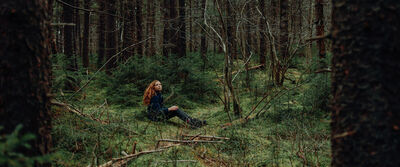
Filmed entirely in Utah, Redford’s minimal use of settings—Anna’s bedroom, a schoolyard, a forest, and a few living rooms—amplifies the story’s theatrical roots. As does the film’s dialogue, in which the actors always seem to be reciting each other’s cues rather than talking with any semblance of natural speech. 

Icky plotting aside, you need strong actors to make a chamber piece like this work. Van Dien does her best with her underwritten character but is often overshadowed by the dynamic presence of Reina Hardesty, who plays her best friend, Brit. Phoenix is out of her depth after the twist, especially in the penultimate scene, which itself contains yet another twist. Garcia is just sort of there, playing a character whose reactions to the film’s plotting make little sense, given his profession.

As Eric, however, Gallner seems to be the only actor given room to craft a little nuance. He’s charming and crafts a believable chemistry with Van Dien. Although Redford chooses to film these early scenes with Eric seducing Anna in a flowery way, they play like stereotypical young love rather than grooming scenes. After the twist, Gallner also brings pathos to Eric, revealing a very broken young man. It’s unfortunate, again, that Redford chooses to film these scenes with as much flair as a generic made-for-TV potboiler. 

“What Comes Around” ultimately exploits the stories of groomed teens like Anna and Eric without bringing insight into its lasting effects. Redford’s film uses this deeply tragic form of abuse as a launching pad for a shallow psychological thriller without much psychology, a morality tale without any morals. 

Now playing in theaters. 

Til Death Do Us Part 0

Til Death Do Us Part

Although it resembles the far sleekier “Ready or Not,” Timothy Woodward Jr.’s actioner “Til Death Do Us Part” never gets near that level of competence. Instead, screenwriters Chad Law and Shane Dax Taylor keep their audience in the dark, any semblance of world-building or storytelling be damned.

We start at what looks like a stock footage recreation of a wedding, but the Bride (Natalie Burn) looks uneasy. Then we cut to what looks like a honeymoon on a sandy Puerto Rican beach. The Bride is flirting and embracing her groom (Ser’Darius Blain) as they talk along the shore. Later that night, they can’t keep their hands to themselves, earning the judgment of an older couple (Jason Patric and Nicole Arlyn) who tells them their love will also fade as theirs has. The story jumps back to the couple’s wedding night, where the Bride gets cold feet and runs off to a family cabin to regroup. Her groom’s coterie of dimwitted and misogynist bachelors show up, inciting violence. It turns out the “university” that the Bride and Groom joked about on the beach wasn’t an academic setting but some kind of nebulous syndicate of assassins that only seem to kill other assassins. If folks complained that the High Table in the “John Wick” series was too much, at least it’s an ethos with rules. Here, it seems like “the university” rules don’t matter or are only meant to be recited through gritted teeth and rewritten but a few moments later. 

The problem with keeping your viewers in the dark about what is happening when and who is attacking who for what reasons is that you can confuse them, and all they can focus on is the mess you’ve made. Not that there is much else to look at: the action sequences are tough to watch between the lackluster fight choreography and the extra shaky camera work during fights that detract from the combatants. The bachelor party’s dialogue is so unpleasant I wanted the Bride to hurry up and finish them all off already. 

There are also occasional filmmaker mistakes and sloppy one-liners, like, “If you’re so tough, come and get me, you piece-of-shit,” delivered with a deadweight thud. Other questionable story and direction choices make the movie downright silly. Towards the end, a major backstory detail is revealed after all the cutting between the bloody wedding day and the beachy honeymoon. It’s as comical as putting a hat on a hat. At this point, it’s a parody. 

Is there anything worth salvaging if your action movie falls flat on the action front? Not in “Til Death Do Us Part.” It feels as if Burn might be channeling a tough Bride character, a la Uma Thurman in “Kill Bill,” but her inability to move past a scowl for most of the movie flattens her performance. Her main antagonist, the Best Man (Cam Gigandet), is more annoying than frightening, especially when leading a group of dudes with nicknames like T-Bone and Big Sexy. Although he doesn’t have much screen time, Blain as the Groom plays the ominous part of a controlling partner, a confident co-conspirator, and a charming date all in one. He may have the movie’s best performance. 

But none of this exhausting movie’s various elements come together at any point—not the story, filmmaking, and acting. It practically assaults its viewer with its dullness; each punch is a reminder of how tiresome each verbal and physical exchange is. I wanted a divorce long before the credits rolled. 

Now playing in theaters. 

Passages 0

Passages

Ira Sachs is one of American cinema’s most reliable crafters of human-scaled cinematic dramas. That description doesn’t sound too terribly exciting, so I should assure you that “Passages” is some kind of time at the movies—a briskly-moving, turbulent, emphatically sexy, deliberately exasperating love triangle in crazy times.

The times in this movie (which Sachs cowrote with Mauricio Zacharias and Arlette Langmann) are crazy, however, because they’re self-perpetuated. While the movie’s set in contemporary Paris, there’s not much in the way of an outside world for its characters to contend with. “Passages” begins on a movie set; the director is Tomas (Franz Rogowski) who’s making a period picture called, well “Passages” (and while I rolled my eyes at this, the doubling of titles ultimately isn’t in the service of any particular meta conceit). Tomas is a tetchy auteur; he micromanages his extras, which means that either he doesn’t have an assistant director to whom to delegate that sort of work, or he’s just That Way. Evidence that follows strongly suggests the latter.

At the wrap party for the shoot, Tomas is joined by his husband Martin (Ben Whishaw), and after a little bantering about whether or not they’ll be dancing, the frustrated Tomas sashays on to the floor with Agathe (Adèle Exarchopoulos), who’s been hanging about the set. They’re intrigued with each other. Agathe has literally just dumped her boyfriend and is extremely available. Tomas, on the other hand, is, yes, married, but he’s also—well the most charitable way to put it is that he’s very open to experience.

The extent to which Martin and Tomas’ relationship is open is never made explicit, but after spending the night with Agathe, Tomas is inclined to overshare, and exuberantly. “I had sex with a woman. Can I tell you about it?”

Martin doesn’t respond enthusiastically, so Tomas continues, “It was exciting! It was something different.” Hey, welcome to the club, Tomas. Anyway. Martin finally responds, “This always happens when you finish a film.” While “Passages” doesn’t spend a lot of time in Tomas’ editing room, its timeline terminates as his film is about to go to Venice. So there is a subtext that we’re seeing this character in a certain extreme state, but the movie doesn’t belabor it; it certainly doesn’t try to use creative work stress to excuse his behavior. Switching up your sexual orientation is an unusual approach to post-production coping, you have to give Tomas that.

Franz Rogowski’s performance as Tomas is fascinating. The way he manipulates those around him is enough to make him borderline repellent, and Rogowski, leaning hard into a speech impediment and all manner of slippery postures, imbues the character with near-rodent-like qualities. Yet one understands why both Agathe and Martin are so physically drawn to him.

And this is the other thing that makes “Passages” a compelling story: Neither Agathe nor Martin are inordinately weak. At different points in the narrative they give in to Tomas and his whiny ways, but they’re not victims. Whishaw’s character is a printer with a sharp eye and a steady-as-she-goes confidence in himself. Exarchopoulos shows how Agathe gets swept up in Tomas’ off-the-wall enthusiasm, but also demonstrates her commitment to living life realistically, as her action after Tomas betrays her very bluntly demonstrates.

After Tomas first takes up with Agathe—during which time he semi-submits to an interrogation from her parents, which may be the sole scene in the movie that compels the viewer to take his side for even a minute—Martin begins an affair with a brilliant young writer/editor, which he’ll cut off abruptly. The writer, Amad (Erwan Kepoa Falé, appealing and understated), understanding what’s up, tells Martin, “You’re weak and you’re sick. You can’t see it yet, but you won’t survive this. Either of you.” The movie’s ending isn’t nearly so cataclysmic, but in its views of a frantic but winding-down Tomas on his own, it tells you that for all the havoc he’s wreaked, he’s learned exactly nothing. And that will keep doing what he does and learning nothing until he burns out. 

Circus Maximus 0

Circus Maximus

A surprise feature film is a bit of a contradiction in terms, but it does sometimes happen, with Beyonce’s brilliant anthology “Lemonade” constituting the richest and most fully realized example. Travis Scott‘s “Circus Maximus,” which showed in AMC Theaters as part of a special arrangement with the chain, isn’t in the same weight class. On the qualitative scale of movies that were created mainly to advertise an album of new songs, it’s probably closer to the Beatles’ slapped-together movie “Magical Mystery Tour,” which was broadcast in the United Kingdom on the day after Christmas, 1967; suffice to say that if you’ve never heard of it, there’s a reason. On the other hand, the “Magical Mystery Tour” did give the world the title track and the “All You Need is Love” video, and there’s a case to be made that the mere existence of an odd and basically uncategorizable film like this should be supported and encouraged just because it’s so different from what usually plays in chain theaters.

“Circus Maximus” is credited as having been written and directed by Travis Scott, but it’s an anthology comprised of work by a lot of other directors, including Harmony Korine, Nicolas Winding Refn, Gaspar Noe, and Kahlil Joseph, and you sort of have to guess who directed what until the end credits. By the time you read this, the film will likely no longer be available in theaters, though it’s possible that it could reappear as a one-off curiousity or midnight movie. 

The movie begins with a science-fiction-y scene of Scott grappling with a squid-like monster which might represent his own demons (or responsibilities, or both), then eases us into an epic journey montage, with Scott crossing various terrains as if he’s en route to drop a cursed ring into Mt. Doom. His ultimate destination, however, turns out to be the home of a guru-like figure played by producer Rick Rubin. The film periodically returns to their conversations, turning them into a framing device of sorts. The conversations border on incoherent—the discussions about connecting people’s energies and not allowing them to be broken sounds like something a musician would say on a press junket when he’s high and not mad at anybody. These talks are shot with an oval-shaped matte around the image that alternately suggests that the speakers are being surveilled through binoculars or watched by a cyclops (sometimes the image “blinks”). 

What follows is a series of music videos, essentially, some better than others, including one shot in Ghana with seemingly hundreds of extras, a sequence directed by Refn in which Scott speeds in a taxi at high speed at night by a creepy crash test dummy driver while calmly smoking weed; “Modern Jam,” a dance floor fantasia co-produced by Daft Punk’s Guy-Manuel de Homem-Christo; and a segment where Scott takes part in a human pyramid in a packed stadium. 

Scott must know he’s courting trouble with crowd imagery—eight fans were crushed at one of his 2021 concerts at Houston’s Astroworld, though a Texas grand jury subsequently declined to indict Scott or anyone else associated with the event. It’s also possible that the beast that embraces Scott in the opening is his guilt, fear of consequences, or something along those lines. But the movie is cryptic or coy about such things. While this is as it should be, in what is basically an experimental film, more clarity of purpose (as in “Gimme Shelter,” the Maysles’ Brothers documentary of the Rolling Stones’ disaster at Altamont) might’ve made the material land harder.

Surely not coincidentally, the music videos fall into two categories, crowd or no crowd. The bulk of the film is a concert done without fans, repeating a lot of the same tracks showcased in the music video portion of the film, and unfolding entirely in the eponymous chariot racing stadium in Rome, which also happens to be the site of the single worst disaster in the history of spectator sports: over 1000 people were killed when the venue’s upper tier collapsed. Scott performs mostly solo, although he’s joined at various points by such collaborators as The Weeknd and Swae Lee, The collaborators make their approach from the outer edges of the stadium and are tracked to the center area, often without cuts. 

Korine appears to be the person in charge of most of the “concert for nobody” sequences. Like the rest of the movie, this footage is shot on 35mm film, an increasingly rare format, and a lot of it was done from the top of a large crane, which allows for fast sweeping movements that are coded as “epic.” Unfortunately, a lot of this footage is too darkly lit, to the point where you can barely see the performers. And there are also moments where it seems like the camera crew either missed whatever moment or composition they were supposed to be capturing or didn’t know what they were supposed to be focusing on. There’s not much memorable choreography to speak of; much of it is more like bouncing, and the more memorable gestures (such as Scott climbing the huge wall of speakers behind him and perching atop it like Batman) are repeated, which lessens their impact. 

Scott is a powerful presence when he’s walking through landscapes and very effective in music videos where he’s silhouetted or wreathed in smoke and strobe lights, but he’s a distant and often cold presence otherwise, especially in conversation scenes with Rubin. He is generally withholding when he’s on-camera, which spells doom for a performer who doesn’t have what could be called, for lack of a better phrase, a film persona (as Prince did). The guest performers generally make a stronger impression even though their screen time is comparatively brief, especially The Weeknd, who has a bit of Mick Jagger’s insouciance (he’s far more charismatic here than he was on HBO’s awful “The Idol“). This is a curiosity and a career footnote more than a substantial freestanding film achievement, which is too bad. It’s more a notion for a work of art than a work of art, and you can’t expect people to pay $25 (the cost of a special engagement ticket opening weekend) for a notion.

In theaters now.

The Unknown Country 0

The Unknown Country

Midnight blues melt into velvety blacks, punctuated by motel signs, gleaming lonely neon sometimes blurred by rain or snow on the windshield. These aren’t national chain motels. You have to get off the interstate to find them. An old guy behind the front desk hands out the room keys and makes friendly banter. He doesn’t find it odd when a customer pulls up at midnight and rings the doorbell. People are on the move in this massive country, to parts known and unknown. They need a warm bed for the night, maybe a friendly face so the road won’t feel so lonely. Inside the chilly room, pink neon floods through the window.

These are some of the images in Morrisa Maltz’s stunning narrative debut “The Unknown Country,” a lyrical and poetic journey, as well as an actual journey, from the snowy wastes of South Dakota’s Badlands to the humid nights of the Lone Star State. Lily Gladstone plays Tana, an Indigenous woman setting out for Texas after her grandmother’s death. The story isn’t “filled in” until later, but the details are almost unnecessary. It is enough to know that Tana is grieving her grandmother and missing what she never had, a sense of an extended community. She drives across the great plains of America, visiting her Oglala Lakota family, people she hasn’t seen in a long time, attending her cousin’s wedding, stopping off in motels, and meeting people along the way. She’s alert to danger when necessary, and for Native women traveling alone, it’s always necessary. But Tana is also open to friendliness and kindness, as shown in a sequence in Texas when she meets a group of people at an outdoor bar and ends up hanging out with them all night, having carefree fun. It’s not an accident that “The Unknown Country” moves from the cold north to the warm south. It’s a process of healing and integration for Tana, who has felt disconnected from her family and, by extension, her entire community. 

In the corporate world, there’s a concept called “touchpoints,” places where a customer interacts with the company. On a human level, “touchpoints” are those random moments where a stranger becomes a friend, where a person behind a convenience store counter makes it a point to connect with a customer, not because they want anything, but because connection with humans is where it’s at. So much of our world seems now designed to help us avoid as many “touchpoints” as possible. “The Unknown Country” shows us what we’re missing.

Maltz uses her background in documentary to create a fluid hybrid of a film, where real people tell their stories in voiceover, people whom Tana meets once before moving on: a cheerful waitress (Pam Richter) committed to giving her customers a happy memory (the film is dedicated to her), a convenience store clerk (Dale Toller) who makes the reticent Tana crack a smile, and shares in voiceover his long-held dream of meeting a man named Cole … and damned if it didn’t come to pass! There are more voices: a man who walked away from a successful engineering career to run a motel with his wife, a dance hall owner in Texas who bought the place so that 90-year-old Flo, a local legend, has a place to dance every night. These voices, homey and intimate, fill the air as Tana drives. There are other voices, too, on the radio. The contrast couldn’t be starker: the voices of real people doing their best and the people on air, perpetuating division and conflict. Post-2016 reality doesn’t even need to be acknowledged outright. It’s in the oxygen.

The film was collectively conceived and written by Gladstone, Maltz, editor Vanara Taing, and Lainey Bearkiller Shangreaux, who appears in the film (and also produced). Gladstone interacts with people playing either a version of themselves or themselves outright. When Tana stops off to visit her cousin (Lainey Shangreaux), she is instantly welcomed by her estranged family. The Shangreauxs are still connected with reservation life (the “rez”), but Tana, from an urban environment, lacks that connection, maybe even shies from it. Tana attends Lainey and Devin’s wedding and plays with their child Jasmine (“Jazzy”), a lively girl who loves dancing and being silly. Lainey tells her story in voiceover, her teenage Romeo and Juliet romance with Devin, sneaking out of windows to see each other, getting pregnant so they had to be together. When Devin says his wedding vows, tears are on his face. These are all incredibly touching scenes, and Gladstone easily immerses herself in this family, smoking butts with her cousin outside and drinking beers in a local pub. She feels welcome, but she also feels her outsider status. Tana stares at a picture of her grandmother, taken in 1940 while on a similar road trip. What was her life like? What can be learned? How can she grieve?

There’s a key scene when Lainey and Tana go visit Lainey’s grandfather, brother to Tana’s grandmother. He and Tana walk through the winter twilight, and he senses, as wise, experienced people often do, Tana’s unanswered questions and her need to know her grandmother, to understand. He gives her a suitcase filled with her grandmother’s possessions. A cotton housedress. A photo. These prompt more questions than answers, pushing Tana on in her quest.

Andrew Hajek’s cinematography is awash in colors and sensitive to the nuances of light: cold or deep, harsh or soft. Lens flares are almost a cliche, but not how they’re used here. Light melts or refracts. Those dark blues and floating neon signs, the “O” of MOTEL reflected in the windshield, the monochromatic snowy landscape, and the deep colors of a windy twilight in the middle of nowhere, all this gives “The Unknown Country” an amazing tactile quality. You don’t watch the movie. You experience it through your senses.

Kelly Reichardt’s “Certain Women” was peopled with giant names: Laura Dern, Michelle Williams, Kristen Stewart. But Lily Gladstone, as the farmhand taking night classes, was the standout. Staring at her sleep-deprived teacher (Stewart) in the front of the classroom after riding her horse to class and sharing a coffee at a late-night diner … Gladstone gives a nearly wordless performance (as she does here, too), but Gladstone doesn’t need words. It’s all on her face. In “Certain Women,” her face told of a kind of yearning, the romantic nature hidden beneath the surface of a hearty woman who works with her hands. It’s so exciting to see her here, too. She doesn’t speak much, but her energy differs greatly from “Certain Women.” Her character here is shyer, and less confident, and her thawing out takes a little longer. It will be even more exciting to see Gladstone in Martin Scorsese’s upcoming “Killers of the Flower Moon.”

The ending scene doesn’t quite land, although the cathartic intention is apparent. What matters is Gladstone’s face, taking in the world around her and all those voices, telling us who they are, what they’ve been through. In the corner of a family photo hanging on the wall of the Shangreaux home is a small piece of paper with a quote from poet Mary Oliver:

“Tell me, what is it you plan to do with your one wild and precious life?”

It’s really the only question.

Now playing in theaters. 

Kokomo City 0

Kokomo City

Imaginatively edited, sexually explicit, and filled with eloquent and often boisterous individuals of a sort who rarely get to claim a spotlight in documentaries, the trans sex worker portrait “Kokomo City” is a blast of creative freedom in an increasingly corporatized period of nonfiction filmmaking. It focuses on four trans women, Koko Da Doll, Daniella Carter, Liyah Mitchell and Dominique Silver, interviewing them in their own homes and ordinary public spaces—sometimes glammed up, but more often with little makeup. The black and white imagery links it to a rich mid-century tradition of American documentaries (typified by films like the Maysles Brothers’ “Salesman” and Shirley Clarke’s “Portrait of Jason”) that focused on personalities and aimed for a fly-on-the-wall feeling. But the structure and editing have a punk rock midnight-movie energy, taking pride in flagrantly ignoring the (purely theoretical!) documentary filmmaking handbook of do’s and don’ts. The cheeky-blasé subtext is: If you don’t like what we’re doing, go watch a different movie.

“Kokomo City” is shot and cut by D. Smith, a Black, trans, Grammy-nominated producer who worked with Lil WayneKeri Hilson, and Katy Perry. Smith was ostracized by the music industry after coming out in 2014 and appeared on season five of “Love & Hip-Hop: Atlanta,” a gig that she now regrets because of how she tried to stand out by (she says) somewhat caricaturing herself. She was also homeless for a while. This movie is a reclamation, a reinvention, and a return. It’s bursting with energy, it’s all over the place, and there are times when it sorta trips over its ambition. But it’s hard to pinpoint, in some faux-objective sense, what does or doesn’t “work,” because it isn’t trying to satisfy any criteria but its own. The whole thing is uncoupled from mainstream/”normie” life and bourgeois concepts of propriety, much like the New York- and Atlanta-based people it depicts. 

The opening scene is an extemporaneous monologue about a sex worker taking a gun away from a client, intercut with hyperbolic recreations that have an almost Pop Art goofiness (like slapstick comedy scenes in a Baz Luhrmann flick). The monologue is filmed handheld and zoomed-in from several feet away from speaker, who is sometimes partly obscured by a doorframe. The framing makes the audience feel it has been granted privileged access to insider knowledge. This feeling persists all the way through through a politically incendiary closing montage with full-frontal nudity, filmed and cut in a way that makes it feel like a 1990s MTV video that MTV would have never dared broadcast. There are partial dramatizations of the subjects’ experiences on the job (some of which feature graphic sex scenes with cartoonishly loud sound effects) and low-key, no-fuss hangout scenes where you get to see intimate moments of a more mundane sort (grooming in a bathroom mirror, canoodling on a couch). Smith uses wall-to-wall underscoring in some scenes, a la Spike Lee, lending gritty documentary material a touch of Old Hollywood grandiosity. 

These markedly different bits sit next to each other in linear sequence, as in an anthology film comprised of short subjects. The movie is not interested in easing viewers out of one mode and into the next. The result feels not only justified but aesthetically right. The common element joining the subjects’ stories is a shared belief, rooted in experience, that most of the world ignores, exploits, or violently persecutes them (one section mourns trans women murdered by clients). So it makes sense that “Kokomo City” wouldn’t trouble itself with questions of appropriateness raised by anyone, even viewers from within the community who might object to how Smith puts certain body parts on display.

The film is aware of outsiders looking in and sometimes addresses them directly. But the material also looks inward at the Black and trans community and the places where it intersects—especially the bedroom. The film’s title is an allusion to blues singer Kokomo Arnold, whose “Sissy Man” includes the lines, “I woke up this mornin’ with my pork grindin’ business in my hand/Lord, if you can’t send me no woman, please send me some sissy man.” The interviewees are understanding yet critical of “trade”—the sullen, straight-acting men, married and single, who bottom with them in secret. “Gay panic” is often used as a defense by clients who know full well what they snuck out and slunk around to get, who cannot reconcile their public-facing macho presentation with the vulnerability and desires that they show behind closed doors, and lie, ghost, or lash out to protect their own illusions. “They wanna see a pretty-ass girl with a big d—,” Koko says. This past April, a few months after “Kokomo City” won awards on the festival circuit, Koko was murdered in Atlanta

Despite the often harsh realities of the life it captures, “Kokomo City” is a fundamentally warm and embracing work. It sets its own boundaries and finds peace within them. The loose-limbed, free-flowing approach to the stories lets each speaker become the star of whatever scene they happen to inhabit. Smith told The Guardian that one of her filmmaking influences was 2016’s “Joker,” especially the scenes that showed the title character living the daily grind without makeup. “I just wanted to re-create the narrative of what trans women truly are,” she said. “We’re human, and this is what we look like. We look like you, we’re fun, and we’re vulnerable like you, and we want love like you.” 

Haunted Mansion 0

Haunted Mansion

From the original ride to now-three of film adaptations, Disney’s Haunted Mansion is properly cemented into the company’s spooky canon. This installment is in line behind 2003’s nostalgic Eddie Murphy chapter and 2021’s Muppets edition. Justin Simien (“Dear White People,” “Bad Hair”) directs this return to a Black-led live-action iteration of the story. 

The simple plot lends to simple execution across the board. Single mother Gabbie (Rosario Dawson) has moved into the antique house of her dreams with her nine-year-old son Travis (Chase Dillon). But not long after stepping into the home, they become blatantly aware of the spirited tenants occupying the creepy abode. Enlisting the help of grieving astrophysicist Ben (LaKeith Stanfield), priest Father Kent (Owen Wilson), medium Harriet (Tiffany Haddish), and haunted house expert Professor Bruce Davis (Danny DeVito), the gang hopes to put their heads together to rid the house of its supernatural tormentors.

“Haunted Mansion” is star-studded but shoddy at best. Despite the talent of writer Katie Dippold (“The Heat” “Parks and Recreation”), the script’s punchlines are forced and flat. Everyone is doled their share of one-liners, but Wilson and Haddish carry most of the weight. While Wilson often runs dry, Haddish delivers in her classic tone and cadence, executing flimsy jokes to her best ability. The script does toe the line of Disney’s boundaries, tossing in some light innuendos in a somewhat concerted effort to draw in more mature audiences.

Simien’s film does display its fun-loving origins in how the house can transform into a surrealist landscape. Halls that never end, ceilings that extend into impossibility, gargoyles, hidden rooms, and the ever-so-classic ghost-inhabited portraits recall nostalgia for the film’s classic Gothicism. “Haunted Mansion” boasts a handful of playful chases and spooky sequences, but they’re fleeting and soon bring us back to the film’s stuttering pace. It’s hard to find any true tension in “Haunted Mansion” until the climactic faceoff in the third act. 

Perhaps the greatest letdown of Simien’s movie is how little the cast delivers. The ensemble is brimming with lively, prolific candidates, yet the script hardly seems to keep this in mind. Their talents are either underused or misdirected. Stanfield’s Ben mourns the loss of his wife, his grief becoming a cornerstone of the story. Yet while we’ve seen Stanfield display emotional depth in other roles, every tearful moment feels like a soap opera, not on account of sentiment, but performance. There’s a sense of watered-down contrivance across the board. The forced, postured will-they won’t-they romance between Stanfield and Dawson showcases this also. And with seasoned comedic actors in Wilson, DeVito, and Haddish, too few of their comedy efforts actually hit. 

“Haunted Mansion” is constructed with the familiar bricks of a Gothic tale, down to the theme of grief that runs throughout. There’s a thoughtful examination of how grief makes us vulnerable while also being able to harness the power of that love to connect with one another and appreciate the lives we lead. There’s also value for family audiences in the nostalgic spookiness that rides along the surface. But with a repeated sourness in the film’s comedic efforts and a tragically misused ensemble, “Haunted Mansion” misses the chance to become a Halloween classic. 

In theaters now.

Bobi Wine: The People’s President 0

Bobi Wine: The People’s President

Though it may not be en vogue to say it, some narratives seem hardwired into our collective unconscious mind, and we have an attachment to them almost as vital as our need for water. We might not often invoke her name, but the Cinderella Narrative is at the root of much of our narrative culture. Another omnipresent story is that of David and Goliath. In fictional filmmaking, this story is inescapable, but it has a powerful hold on non-fiction film as well. 

The big difference is that in non-fiction, the outcome is not always predetermined. The stone might miss Goliath’s temple. So the focus shifts to why David decided to pick up his sling, even if his aim may, in the end, falter. 

This applies to the new documentary “Bobi Wine: The People’s President,” directed by Christopher Sharp and Moses Bwayo. Sharp is a second-generation Ugandan-born Englishman, and Bwayo, who also serves as one of the film’s cinematographers, is Ugandan. For five years, including inevitably the onset of the coronavirus pandemic, they shadowed and filmed the unlikely rise of Robert Kyagulanyi Ssentamu to a place of prominence in Ugandan politics. Kyagulanyi, performing under the name Bobi Wine, is a pop musician whose music (a blend of reggae, dancehall, and Ugandan kidandali) has made him a big name. However, Bobi Wine risks it all when he decides to enter politics, taking a seat in the Ugandan Parliament before deciding to run for president.

The incumbent is Yoweri Museveni, a septuagenarian war hero who took up arms against the infamous Ugandan dictator Idi Amin only to become a de facto dictator himself after losing a presidential election and launching a civil war to take power. Museveni has ruled Uganda since 1986. 

The filmmakers construct this documentary as a first-person account of Wine and his formidable wife, Barbie. Their unlikely courtship—a good girl from a middle-class family falling for a musician from the streets with no family to speak of—feels like something out of Old Hollywood. The differences between the two are the secret to this dynamic union, and Wine would probably have never transitioned from pop idol to statesman without her influence and counsel.

All dictators are, to some degree, creatures of the media, and every strongman’s worst nightmare is being challenged by a beloved entertainer. Museveni is threatened by Wine and uses his army and police to go to war with Wine’s National Unity Platform opposition party. Wine is arrested and brutalized, which temporarily forces him into exile as he tries to raise international awareness of Museveni’s abuse of power. 

The documentary balances footage from the news (both Ugandan media and from abroad) with their footage from inside Wine’s inner circle to the violent clashes between Wine’s supporters and the army. The film is in many ways a spiritual sibling to Marshall Curry’s 2005 Oscar-nominated documentary “Street Fight,” which tells the story of (now-) U.S. Senator Cory Booker’s first failed attempt to become the Mayor of Newark as his campaign is smothered by incumbent Sharpe James who ruled Newark in ways strikingly similar to Museveni. 

The differences between “Street Fight” and “Bobi Wine” are telling. Curry narrates the former doc and provides valuable insight into the history of Newark and how Sharpe James went from being part of the post-Civil Rights reformer wave to betraying all the ideals of that movement. Sharp and Bwayo let Bobi and Barbi tell their own story, which is currently one of the preferred modes of non-fiction film storytelling. Wine does convey that Museveni was once his hero, but because the documentary chooses a more participatory-observational approach, we miss a lot of important Ugandan history that provides much-needed context so that we can understand what taking Museveni on means. 

What Sharp and Bwayo do manage to capture in vivid detail is Uganda itself from the high energy of the capital city Kampala to the lush beauty of the northern country. The beauty of the land clashes dramatically with the ugliness of the presidential campaign, which Museveni turns into a civil war in all but name to retain power at any cost. Needless to say, the documentary arrives at a moment when strongman politics are ascending worldwide, even in American national politics.

It will only take a few seconds on Google to tell you how this election ends, but what only the film can do is show you how Bobi Wine evolves into a powerful spokesman for democratic values as he tries to save Uganda from autocracy. This film will undoubtedly inspire others to stand up like Bobi and Barbie, even though “Bobi Wine” is also clear about the cost of putting a stone in your sling. 

Now playing in theaters.